
The Conversation You Skip Because It Feels Too Early
Equal equity, no vesting, and a handshake. Here is how that becomes a year-long dispute.

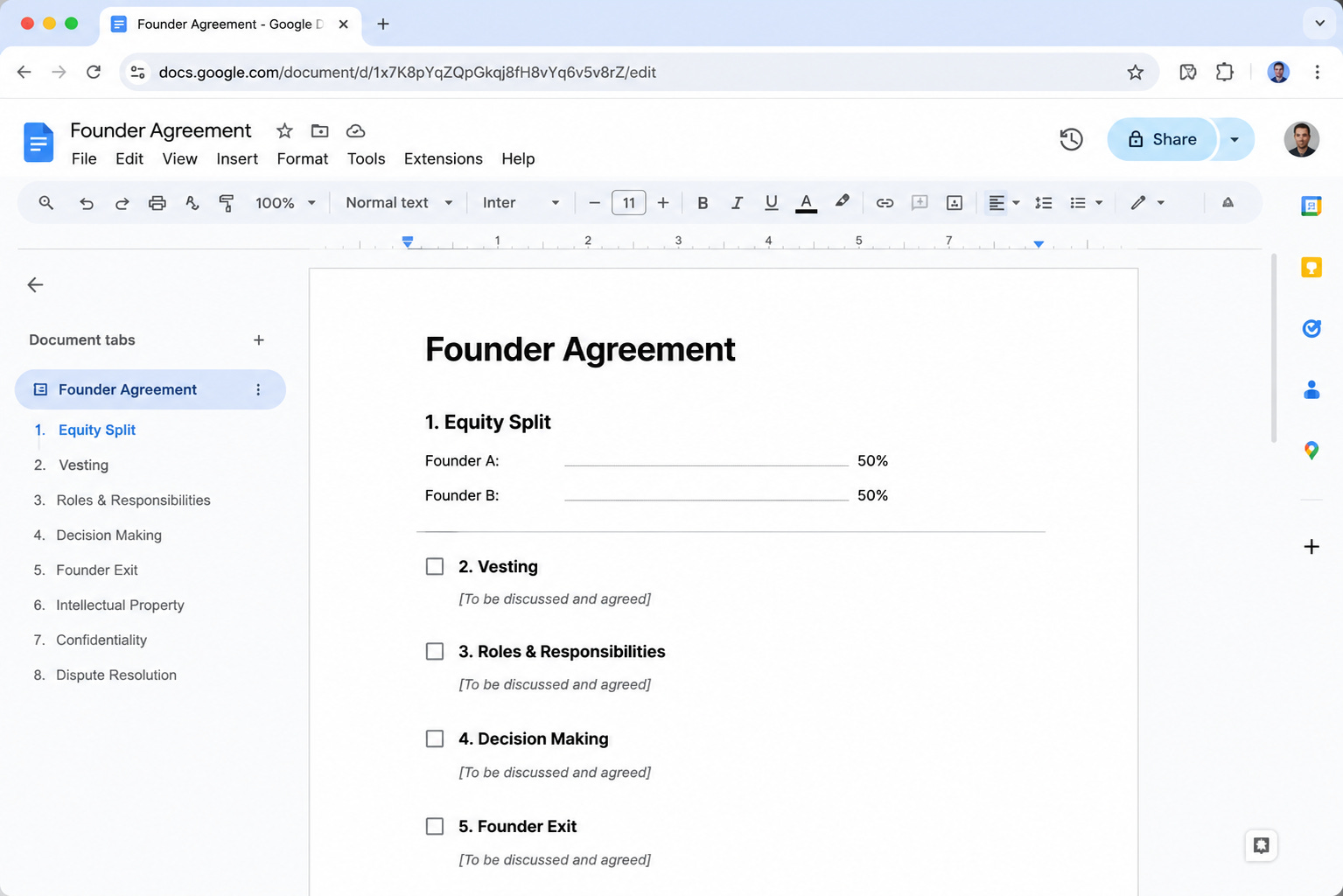
Two co-founders started a climate hardware company together in 2022. Equal equity. No vesting. A handshake and a Google Doc.
Eighteen months later, one of them stopped showing up. He kept his shares. He had done nothing to earn the other half of the company since month six.
The remaining founder spent the next year building the business and negotiating with a co-founder who had become, in every functional sense, a stranger with a large stake in the company.
This is not a rare story. It is the default outcome when founders skip the conversation that feels too early to have.

The conversation founders avoid
Most co-founders meet, get excited, and start building. The equity split happens in the first conversation, usually decided in minutes, usually equal by default because equal feels fair and avoids conflict.
Equal is not wrong. But undiscussed is always wrong.
The problem is never the number. The problem is that founders skip the four conversations that should happen before the number is agreed, and discover the gaps only when something goes wrong.
The vesting schedule that was never set
Equity without vesting means a co-founder owns their full stake the day the company is incorporated, regardless of what happens next.
If they leave in month three, they keep the same percentage as a founder who stays for the next eight years.
Standard vesting is four years with a one-year cliff. Nobody owns anything until they have been there for twelve months. After that, equity vests monthly or quarterly until the four years are complete.
This is not a sign of distrust. It is the single most standard term in venture-backed companies, and investors will require it retroactively if you do not set it yourselves. Better to set it on your own terms than have a term sheet force it later.
The unequal contribution that was never priced
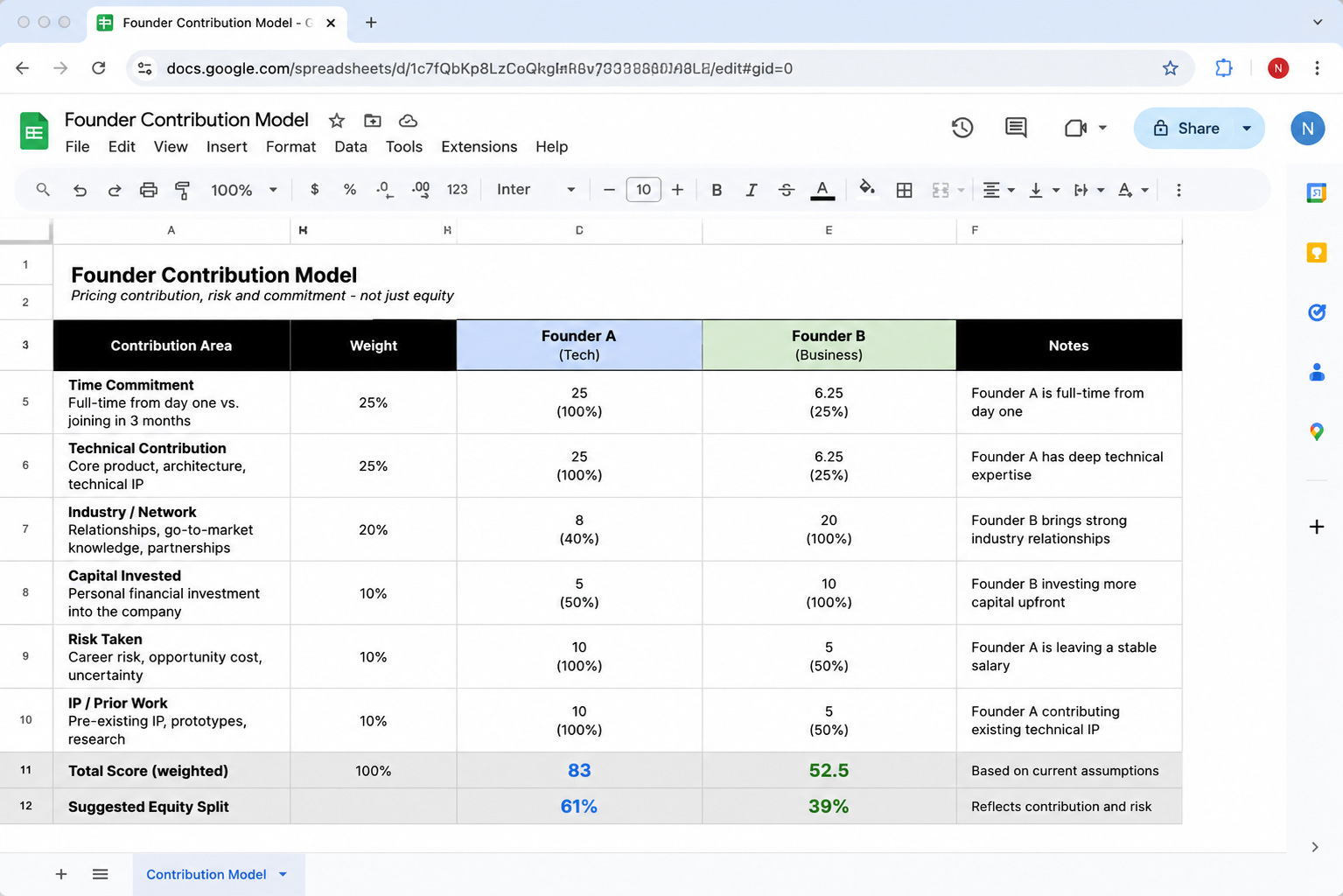
Two people rarely contribute identically. One has the technical background. One has the industry relationships. One is full-time from day one. One is finishing a notice period and joining in three months.
A 50/50 split assumes identical contribution, identical risk, and identical commitment. It is rarely true, and pretending it is true does not make it true. It makes it unresolved.
Price the actual contribution. Time invested, capital invested, IP contributed, risk taken on. A founder who quits a salaried job on day one is taking a different risk than a founder who joins after the seed round closes. The split should reflect it.
The roles that were never defined
Co-founders often split equity before they split responsibility. This works until a decision needs to be made and both founders believe they have final say.
Define who owns product, who owns the technical roadmap, who owns fundraising, who owns hiring. Define what happens when the two of you disagree on a decision that falls inside someone’s defined ownership.
Climate hardware founders in particular tend to skip this, because the early months are dominated by the science and not the org chart. The org chart catches up eventually. It is cheaper to define it before the first real disagreement than during it.
The exit clause that was never written
The hardest conversation is the one about what happens if it does not work between the two of you.
What happens if a co-founder wants to leave. What happens if a co-founder is asked to leave. What happens to their equity, their vesting, their involvement in decisions, their access to company information, after they are no longer working in the business.
Without this in writing, every departure becomes a negotiation conducted under maximum emotional and financial stress, exactly when both parties are least equipped to negotiate fairly.
Write it before you need it. Nobody can write it well after the relationship has broken down.
Prompt 1:
Run this before you finalise any equity split. It will not give you the right number. It will force the conversation that produces the right number.
Job: surface the assumptions behind your proposed equity split before you commit to it.
Paste in your proposed founder equity split and a short description of each founder’s role, time commitment, and contribution to date. Then ask:
Read this proposed equity split.

Tell me what assumption about future contribution, commitment, and risk this split
implies for each founder.

Then tell me what would have to be true for this split to feel fair in three years,
not just today.

Identify the single biggest point of future disagreement this split does not address.
What’s behind the paywall
The conversation above will get you to a fairer split. What comes next gets the rest of the agreement in writing.
Paid subscribers get the full prompt library:
Prompt 2: The Vesting Stress Test. What your proposed vesting schedule actually implies for each founder if either of you left in month six, month eighteen, or month thirty-six. Built to catch the unfairness before it happens, not after.
Prompt 3: The Roles and Decision Rights Map. Which decisions are not currently owned by either founder, who should own them given your backgrounds, and what happens when you disagree on a decision inside the other founder’s territory.
Prompt 4: The Departure Clause Draft. What happens to vested and unvested equity, company access, and decision-making if a founder leaves voluntarily or is removed for cause. Drafted before either of you needs it, while you still like each other.
All three prompts, plus the contribution prompt above, in one place.
Upgrade to Pro to unlock it now.
