
The Same Deck, Five Years Apart
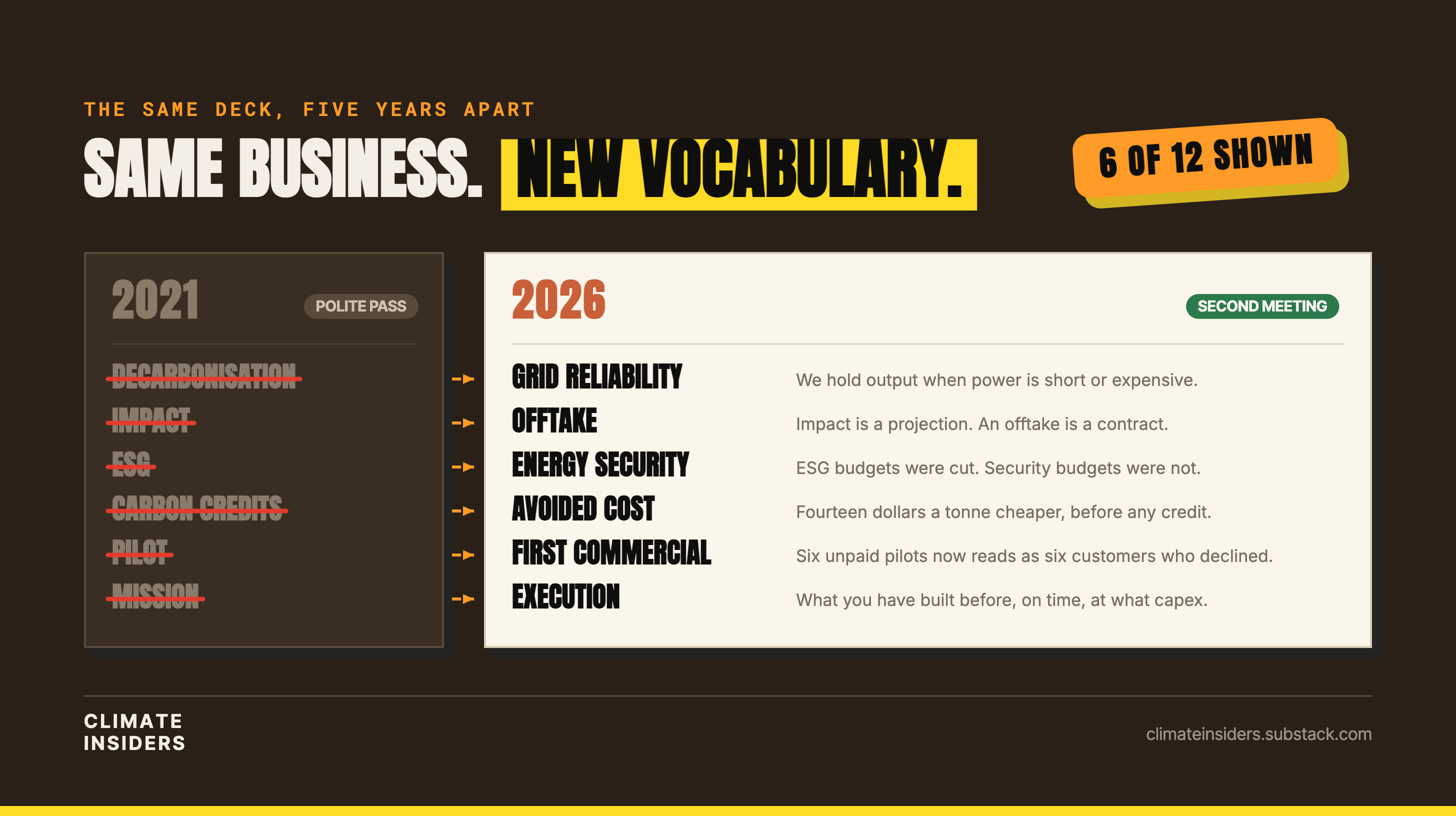
Same business, same physics, twelve different words. The climate deck that failed in 2021 and the one that closes in 2026 are the same document with a new vocabulary.
Read time: 9 minutes
I have read a lot of climate decks from 2021, and a lot from 2026.
Here is what almost nobody says out loud about the difference. The businesses did not change. The physics did not change. The unit economics barely moved. What changed is the vocabulary, and the founders who updated their vocabulary are raising while the founders who did not are being told the market is difficult.
The market is not difficult. The market is using different words, and it stopped telling you which ones.
The thing that actually happened between 2021 and 2026
In 2021 a climate deck was underwritten by a thesis about the future. Carbon would be priced, capital had committed to net zero, and the buyer of your product was a corporate sustainability officer with a target and a budget.
In 2026 a climate deck is underwritten by a thesis about the present. Electricity is short, supply chains are exposed, and the buyer of your product is an operations executive with a cost problem or a reliability problem. Sustainability still signs off. Sustainability no longer signs the cheque.
Every word swap below is downstream of that one shift. The founder is not being asked to abandon the mission. They are being asked to name the buyer who exists rather than the buyer who was promised.
The twelve words that changed
I went through my own reading from both years and pulled the substitutions that appear again and again. Not stylistic preferences. Substitutions where the old word gets you a polite pass and the new word gets you a second meeting.
1. Decarbonisation became grid reliability
2021: "We decarbonise industrial heat."
2026: "We hold output when power is short or expensive."
The tonnes are identical. The second sentence describes a problem the customer has this quarter.
2. Impact became offtake
2021: "Our impact potential is 40 Mt CO2e a year."
2026: "We have a ten-year offtake with a counterparty rated BBB plus."
Impact is a projection. Offtake is a contract. One of those can be diligenced.
3. ESG became energy security
2021: "Aligned with our customers' ESG commitments."
2026: "Removes a single-source dependency on an imported input."
ESG budgets were cut. Security budgets were not.
4. Carbon credits became avoided cost
2021: "Revenue from carbon credit sales at $80 per tonne."
2026: "We are $14 per tonne cheaper than what they do today, before any credit."
If your model needs the credit, the credit is your business and the technology is your hobby. Investors learned that between 2022 and 2024 and it cost them money.
5. Sustainability-led became operations-led
2021: "Champion in the sustainability team."
2026: "Champion in operations, with sustainability as a co-signer."
Naming the wrong champion tells an experienced investor your pilot will never convert. It is the single fastest tell in a climate deck.
6. Total addressable emissions became serviceable revenue
2021: "2.4 Gt of addressable emissions."
2026: "$410M serviceable, capacity limited to 14% until 2028."
A tonne is a unit of atmosphere. A market is a unit of somebody's budget. I wrote a whole post on this one because it kills more rounds than any bad idea.
7. Scaling became bankability
2021: "We scale to a gigatonne by 2035."
2026: "Project three is financeable at 70% debt because of the structure below."
In 2021 the growth question was how fast. In 2026 it is who lends against it, because equity stopped being willing to fund steel alone.
8. Pilot became first commercial
2021: "Six pilots running with major industrials."
2026: "One paid unit at commercial terms, and here is what the second one costs us."
Six unpaid pilots now reads as six customers who declined to buy. In 2021 it read as traction.
9. Green premium became cost parity path
2021: "Customers pay a 20% green premium."
2026: "At plant two we are at parity, and here is the specific line item that gets us there."
A premium is a hope about somebody else's procurement committee. A parity path is arithmetic.
10. Climate tech became industrial technology
2021: "We are a climate tech company."
2026: "We are an industrial technology company. The decarbonisation is a consequence."
Some of the best 2026 raises removed the word climate from the first slide entirely, and put it back on slide eleven where it functions as a moat rather than a category.
11. Policy tailwind became policy resilience
2021: "The IRA creates a $2B tailwind for our category."
2026: "Without the 45Q credit our gross margin goes from 42% to 27% and the plan still works."
Every climate investor has now been burned by a policy that moved. Naming the downside yourself is the whole move.
12. Mission became execution
2021: The team slide leads with why we care.
2026: The team slide leads with what we have built before, on time, at what capex.
The mission is why you started. Nobody underwrites it. In 2026 the mission belongs in the last thirty seconds, where it stops being a claim and becomes an explanation for why this team will not quit.
Why this is not cynicism
The uncomfortable read on this list is that climate founders are being asked to hide the point of their company. That is not what is happening.
Every substitution above moves the pitch from a claim about the future to a fact about the present. That is not a retreat from the mission. It is what the mission looks like once it has a customer. The 2021 vocabulary was the vocabulary of a market being created by policy and by pledges. The 2026 vocabulary is the vocabulary of a market being created by physical scarcity and by cost. The second market is smaller in ambition and enormously more real, and it pays.
The founders who resent this are usually the founders whose businesses only worked in the first market. That is worth knowing about your own company before an investor tells you.
The test you can run on your own deck in five minutes
Open your deck. Count how many of your first five slides contain a number denominated in something other than currency. If the answer is three or more, you are still pitching 2021.
Then find the sentence that names who pays. If it takes you more than ten seconds to find, it is not in the deck, and every investor who passed on you this year passed on that.
Below the wall this gets concrete.
There is the full annotated pair: a 2021 seed narrative and the 2026 Series B narrative for the same business, slide by slide, with what changed on each one and why the change moved the meeting. There is the rewrite checklist, which is the fourteen-item pass I run on a 2021-era deck to bring it forward, in the order that matters. There are the four swaps that go the wrong way, because some 2021 language is stronger than what replaced it and the current fashion is throwing it away. And there is the Claude prompt that runs the whole vocabulary audit on your own deck and hands you the rewrite.
If your deck was written before 2024 and has not been rebuilt since, this is the half that changes the outcome.
