

Read time: 3 min
Spending time in the US again after years in Europe has been strangely disorienting.
I lived six years in the US.
Then almost ten back in Europe.
And for a while, I felt done with the comparison game.
But over the last months, I’ve been back in the US more often.
For investing.
For business.
For helping startups expand.
And something hit me again. Hard.
The US is still optimizing for the wrong things.

For years, Berlin was my base.
Not a perfect city. Not even close.
But a place designed, at least in spirit, around collective life rather than individual performance.
Then I land in the US again.
And suddenly I’m surrounded by extreme personal optimization.
$300 monthly gym memberships.
Sleep trackers.
Continuous glucose monitors.
Supplements.
Longevity protocols.
Biohacking routines discussed with near-religious seriousness.
Everyone trying to fix themselves.
Individually.
Meanwhile, the systems around them feel crumbling.
In Berlin, few people talked about optimization.
People just lived.
You walk everywhere because the city allows it.
You bike because it feels normal and safe.
Public transport mostly works.
Green spaces are part of the city, not an afterthought.
Childcare is imperfect but understood as a collective responsibility, not a luxury upgrade.
Life isn’t optimized.
It’s supported.
And that distinction matters more than we admit.

Back in the US, I keep seeing brilliant founders building products to patch over systemic failures.
Mental health apps to survive impossible work rhythms.
Wellness startups to compensate for cities designed around cars.
Longevity tech to offset chronic stress.
Productivity tools to squeeze more output from already exhausted people.
The irony is obvious.
The US has some of the best health and wellness technology in the world.
And yet, in many major cities, people can’t rely on basic infrastructure.
Can’t commute without friction.
Can’t afford childcare.
Can’t disconnect without guilt.
So we sell solutions to cope.
What Berlin reminded me of, and what Europe keeps showing in different forms, is this:
Wellbeing scales best when it is baked into the system.
Not when it’s sold as a subscription.
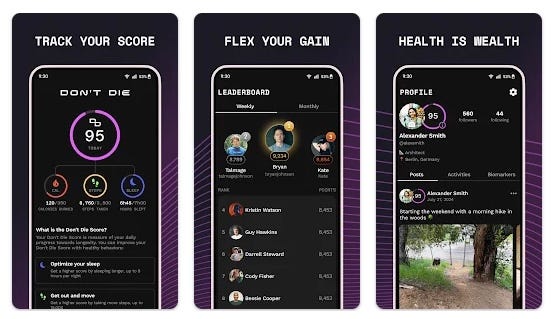
In many parts of Europe, wellbeing is boring.
And that’s the point.
It doesn’t require discipline.
It doesn’t require tracking.
It doesn’t require optimization.
It just happens because the environment allows it.
This is something I think about constantly as an investor.
Especially in climate, energy, health, and infrastructure.
We love building tools that help individuals adapt.
But the real leverage is in systems that make adaptation unnecessary.
Clean energy that stabilizes grids instead of carbon offsets that ease guilt.
Walkable cities instead of stress reduction apps.
Reliable public transport instead of productivity hacks.
Affordable housing instead of resilience coaching.
One approach treats symptoms.
The other changes outcomes.
Coming back to the US, I see ambition everywhere.
Talent everywhere.
Capital everywhere.
But also exhaustion.
And it makes me wonder if the next wave of truly meaningful companies won’t be the ones that help people optimize themselves.
But the ones that quietly redesign the conditions around them.
The most powerful founders I know are starting to think this way.
Less about fixing humans.
More about fixing systems.
That’s where impact compounds.
That’s where capital follows.
That’s where the future gets built.
The question isn’t how we help people live better.
It’s what kind of world makes living better the default.
Yoann
PS: Bryan Johnson. Billionaire. Obsessed with optimizing everything. Body. Time. Life. Years chasing meaning. Love came last.
If that feels backwards, it should.

Ready to go deeper?
Some of my portfolio startups have raised their Series A and B rounds in the last months.
They didn’t just get lucky, they had an unfair advantage.
The right strategy. The right tools. The right data.
I’ve pulled together everything that actually worked for them: the tools, templates, and investor contacts those founders have used to raise enormous money.
📌 The Ultimate Investors List of Lists (12,000 VCs, FOs, Angels)
💰 The Investor List No One Talks About: 140 Family Offices
🦄 40 pitch decks that built Unicorns (how Airbnb, Coinbase, Canva got funded)
⚡️ The Ultimate Notion Data Room (all key docs you’ll EVER need)
🥇 The Most Successful Investor Update Template
📊 The Only Finance Tracker Your Startup Needs
⚖️ SAFE Note Dilution Calculator & Cap Table Builder
👯 Co-Founder Agreement Templates + Legal Clauses You Can’t Forget
Love this!
I sure wish I had written that!